
Return on Equity and Leverage
Educational content, not investment advice. See our Disclaimer.
What return on equity measures
Return on equity (ROE) divides a company’s net income for a year by its shareholders’ equity — the book value left for shareholders after every liability is subtracted from assets. A company with $10 million of net income and $100 million of equity has an ROE of 10%: it produced ten cents of profit for every dollar of the owners’ capital. Both figures come straight from the financial statements: net income from the income statement, equity from the balance sheet.
Debt-to-equity
Debt-to-equity divides a company’s total debt by its shareholders’ equity. A ratio of 0.5 means the company has borrowed fifty cents for every dollar the owners have put in; a ratio of 2 means it has borrowed two dollars. What counts as high depends heavily on the industry — banks and utilities routinely run ratios that would be alarming for a software company — so the number is most useful compared with direct peers and with the company’s own history.
How leverage inflates ROE
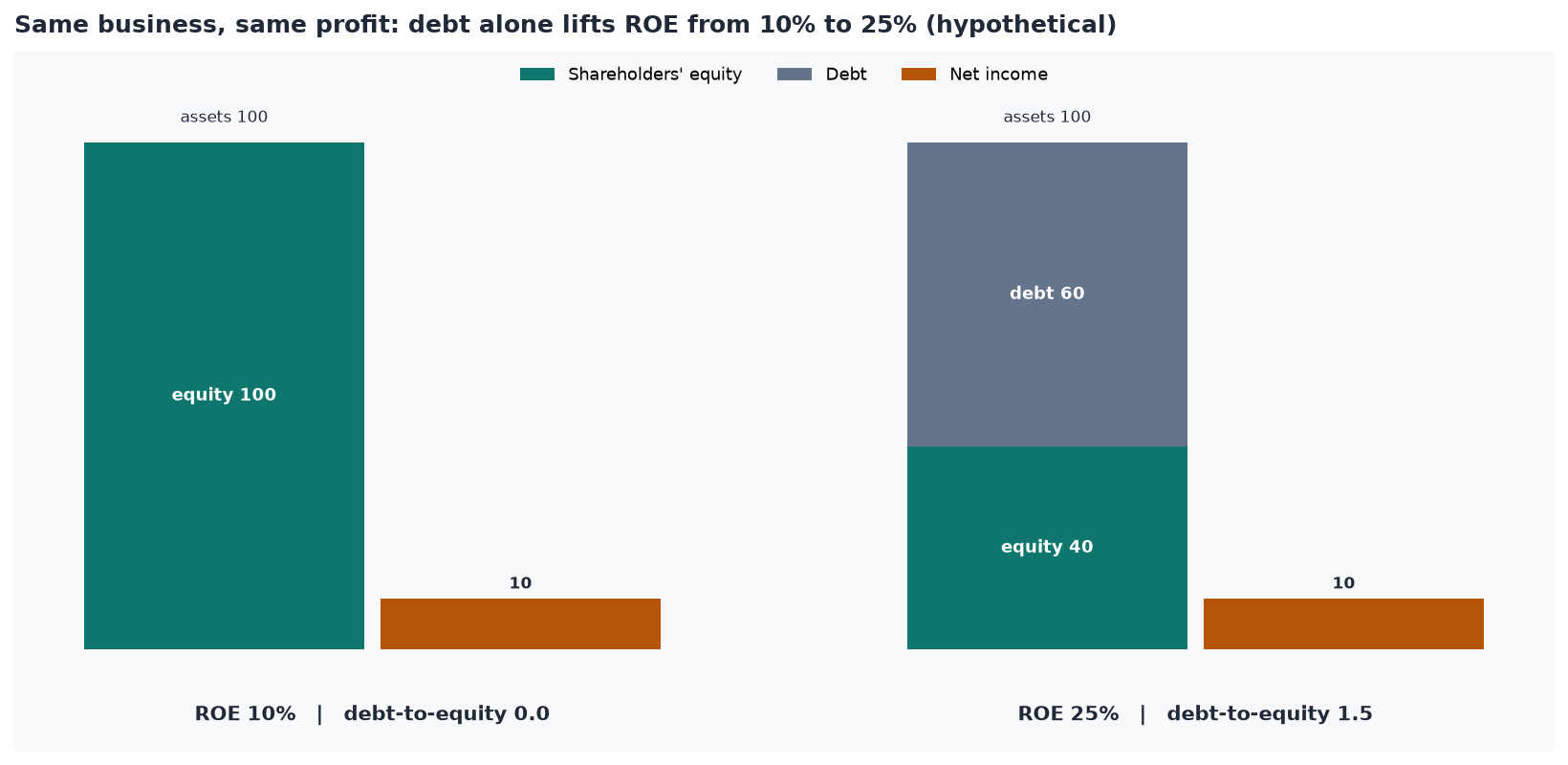
Take two companies with identical businesses: each owns $100 of assets and earns $10 a year. The first funds its assets entirely with equity, so its ROE is $10 ÷ $100 = 10% and its debt-to-equity is 0. The second funds the same assets with $60 of debt and $40 of equity, so its ROE is $10 ÷ $40 = 25% and its debt-to-equity is 1.5.
Nothing about the second business is better. It simply uses less of the owners’ money and more borrowed money, and ROE rewards that. In reality the debt also carries interest, which would reduce net income somewhat — but the basic effect holds: more leverage pushes ROE up, and it also leaves the company more exposed when earnings fall.
Other things that distort ROE
Share buybacks reduce equity, which raises ROE even if profits do not change. Accumulated losses or large buybacks can push equity to zero or below, at which point ROE becomes meaningless or negative for reasons unrelated to how the business is doing. One-off gains, such as selling a division, can inflate net income for a single year. A single year’s ROE is a starting point for questions, not an answer.
Why screens pair ROE with debt-to-equity
Because leverage can manufacture a high ROE, a screen that only asks for high ROE tends to collect heavily indebted companies along with genuinely efficient ones. Adding a ceiling on debt-to-equity removes most of the first group. That is exactly how the Daily Study’s Long-Term Universe screen works: return on equity of at least 15% and debt-to-equity of at most 1, among companies worth at least $10 billion. Even then, passing the screen only means a company fits that definition — the financial statements are still where the real reading happens.