
Reading the Balance Sheet
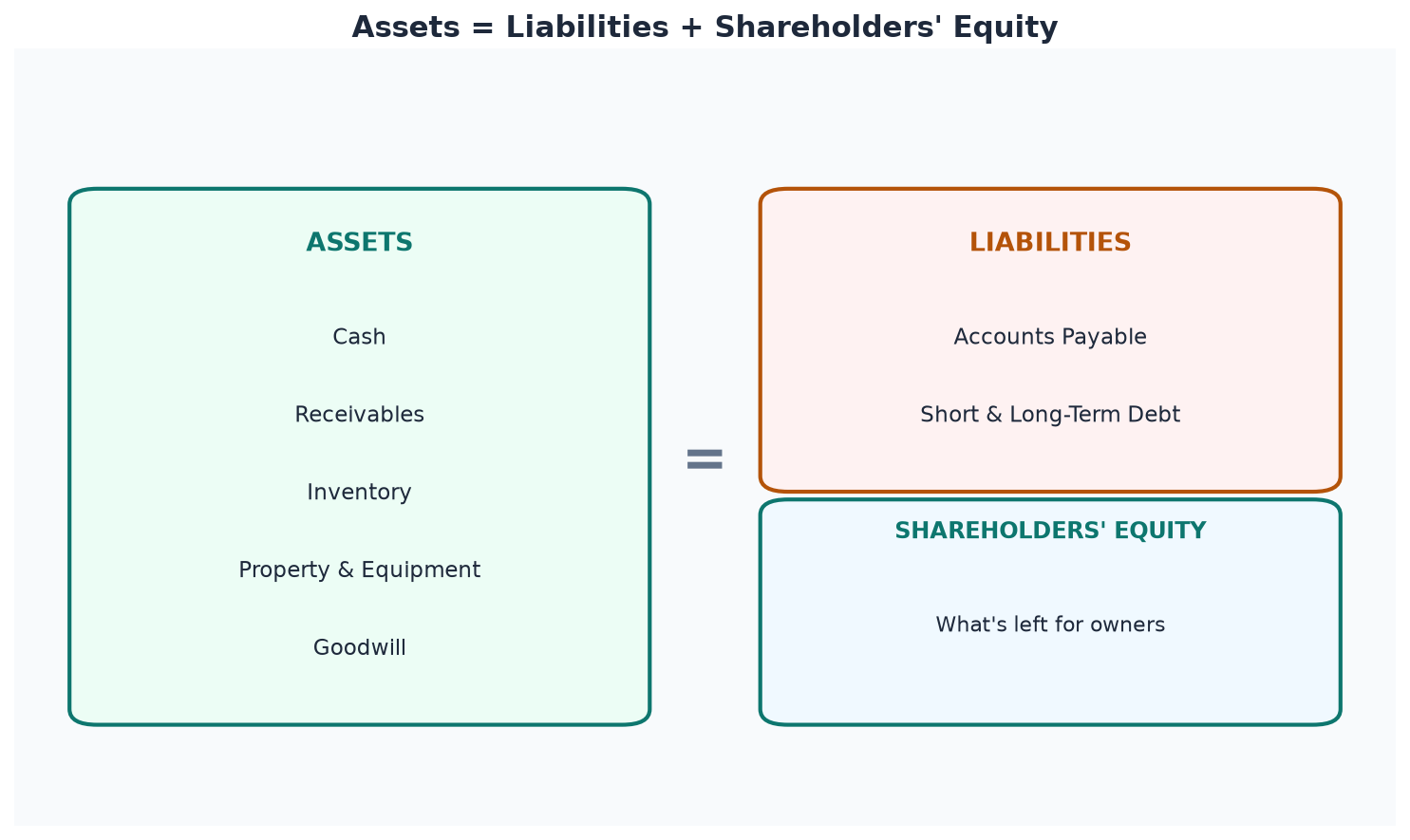
Where the income statement covers a period of time, the balance sheet is a snapshot at a single moment: everything a company owns, everything it owes, and the difference between the two. It rests on one identity that always has to balance, which is where the name comes from: Assets = Liabilities + Shareholders’ Equity.
Assets
Assets are listed from most to least liquid. Current assets — cash, short-term investments, accounts receivable, inventory — are things expected to convert to cash within a year. Non-current assets — property, equipment, long-term investments, goodwill and other intangibles from acquisitions — are the longer-horizon holdings. A company’s cash position deserves particular attention: for a business that isn’t yet profitable, cash on hand relative to how much it’s spending each quarter (its “burn rate”) determines how many months of operation remain before it needs to raise more money, which is a direct input into dilution risk (dilution is what happens when a company issues new shares and each existing share’s claim on the business shrinks a little — covered in full in the final lesson).
Liabilities
Liabilities follow the same current/non-current split: current liabilities (accounts payable, short-term debt, accrued expenses) are due within a year; non-current liabilities (long-term debt, deferred tax liabilities, lease obligations) extend further out. The relationship between current assets and current liabilities is captured in the current ratio (current assets ÷ current liabilities) — a ratio below 1 means a company’s near-term obligations exceed what it has readily available to pay them, which is a real liquidity warning sign worth investigating further rather than ignoring.
Shareholders’ Equity
What’s left after subtracting total liabilities from total assets is shareholders’ equity — the accounting value attributable to owners of the company, and the basis for the book value concept introduced earlier in this course. A negative shareholders’ equity figure (liabilities exceeding assets) is a serious red flag worth understanding before forming any view on a stock, though it isn’t automatically fatal — some capital-light, high-growth businesses can run negative equity for a period while still being fundamentally healthy, which is exactly why context and trend matter more than any single number.
A Specific Phrase Worth Knowing: “Going Concern”
Auditors are required to flag, in plain language inside a company’s filings, any substantial doubt about whether the business can continue operating for the next twelve months. This language is usually called a going concern warning, and it typically appears when a company’s current liabilities meaningfully exceed its current assets (negative working capital) with no clear, credible plan to raise additional capital or cut costs. Finding this phrase in a filing doesn’t mean a company is guaranteed to fail, but it is one of the most direct, unambiguous signals a balance sheet can carry, and it’s worth specifically searching a company’s recent filings for.