
Top and Bottom of the Screen: An Ordering, Not a Verdict
Educational content, not investment advice. See our Disclaimer.
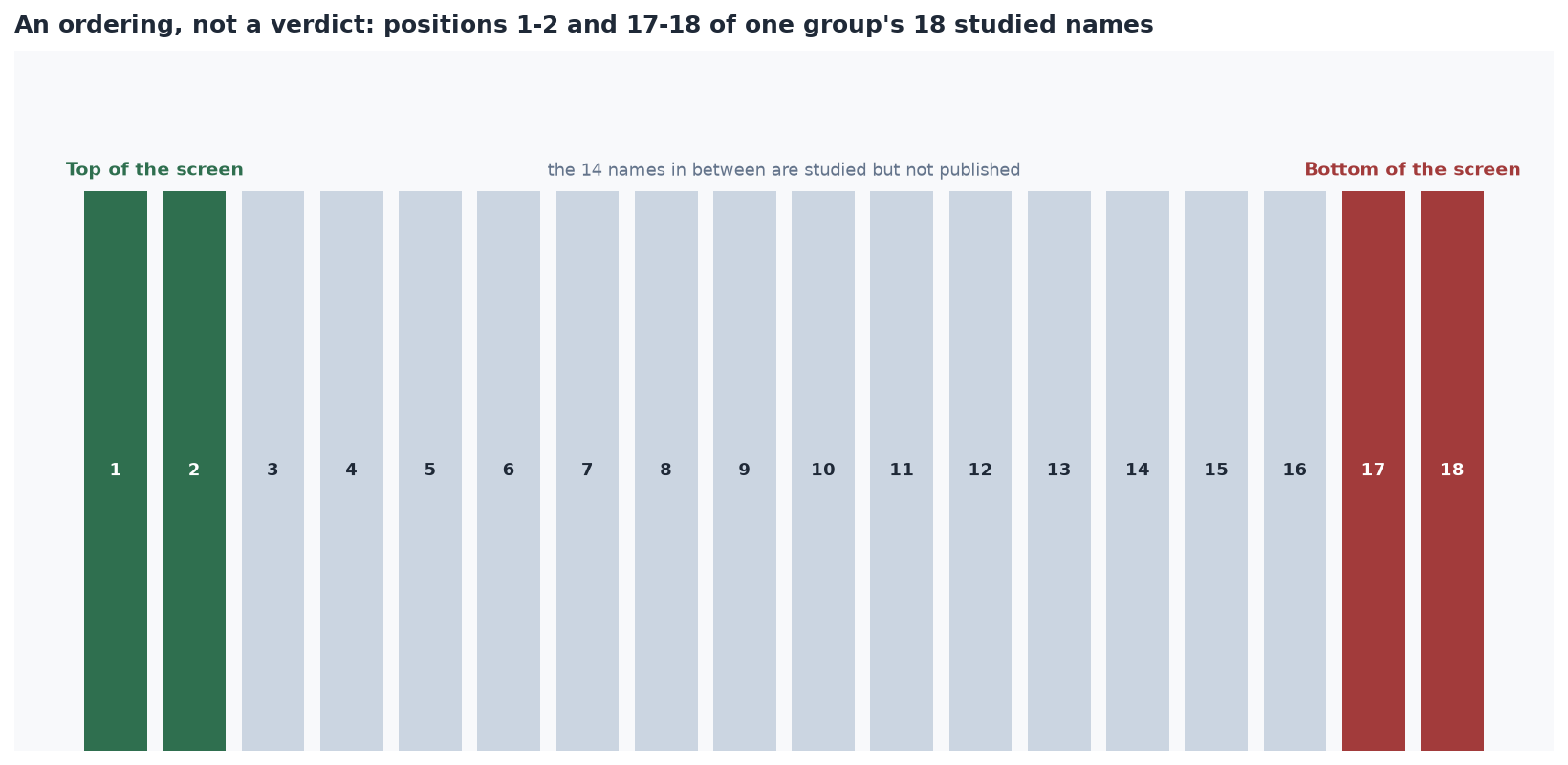
How the names are ordered
Every studied name is measured the same way — recent price behavior, trend, volatility, and the fundamentals available for it — and the measurements are combined into a single composite. The names are then sorted by that composite, from first to last, within their own group.
The composite is never published. A number next to a ticker invites being read as a rating, and a rating invites being read as advice. What the Daily Study publishes is the position — top or bottom — and then the actual, verifiable measurements behind it, so you can see for yourself why a name landed where it did.
What "top" and "bottom" actually mean
Top of the screen means a name ranked first or second among the names studied in that group on that day. Bottom of the screen means it ranked last or second to last. Both labels are relative to a small set of 18 to 22 names that had already passed the same screen — not to the whole market.
That matters. The bottom of a group of large, profitable companies is still a large, profitable company. It simply measured weaker than its peers on that day’s composite.
Why show both ends
Showing only the top of a list tells a one-sided story. Putting two names from each end side by side, measured with exactly the same tools, makes the contrast visible: what does a name that measured strongly look like next to one that measured weakly, inside the same group and on the same day?
On 2026-10-05, the Swing group’s top was Permian Resources (PR) and Plains All American (PAA); its bottom was Flagstar (FLG) and Taysha Gene Therapies (TSHA). FLG’s case study shows why it sat at the bottom: it closed below both its 50-day and 200-day moving averages, about 20% of the way up its 52-week range, with a 14-day RSI of 18. Those are descriptions of what the price had already done — the later lessons in this course explain each one.
Common misreadings
Top does not mean buy, and bottom does not mean sell. The ordering describes the recent past. A name at the bottom after a long decline and a name at the top after a long rally can both reverse the next day.
The ordering is not stable. It is recomputed every session. A name can move from top to bottom within a week without anything changing in the business.
The green and red borders mark position, not quality. They are there to make the two ends easy to tell apart at a glance, nothing more.