
Reading the Cash Flow Statement
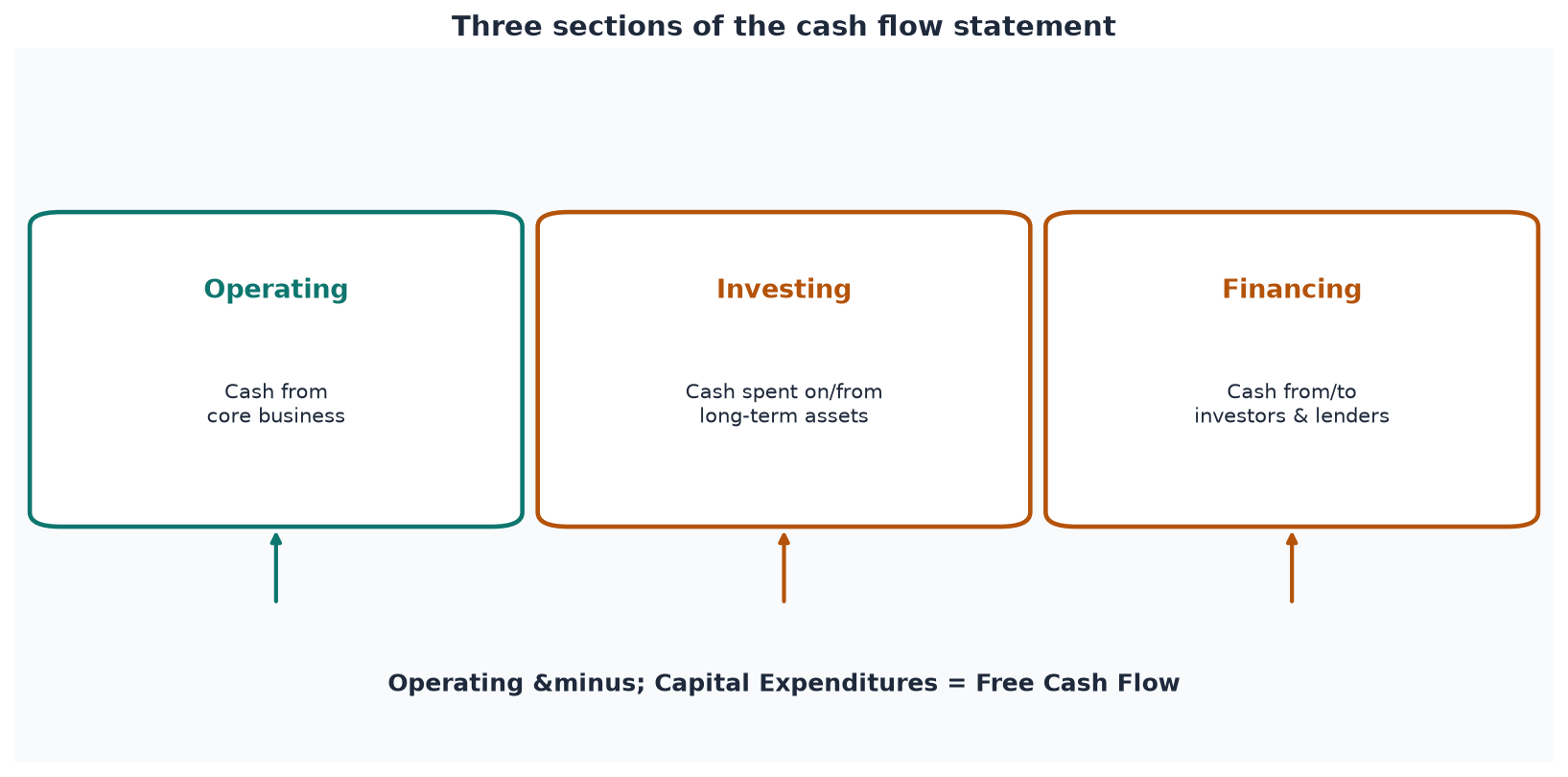
Net income, on the income statement, includes non-cash accounting items — depreciation, stock-based compensation (paying employees partly in stock instead of cash), changes in estimated reserves — that don’t correspond to actual cash moving in or out of the business. The cash flow statement strips all of that away and answers a more literal question: how much real cash did the company generate or consume this period? It’s split into three sections.
Operating Cash Flow
Operating cash flow measures cash generated by the core business — starting from net income and adjusting for non-cash items and changes in working capital. This is often considered a more honest profitability signal than net income alone, because it’s harder to flatter with accounting choices. A company posting positive net income but negative operating cash flow for several consecutive quarters is a pattern worth understanding before trusting the income statement’s version of events at face value.
Investing Cash Flow
Investing cash flow covers money spent on or received from long-term assets: purchasing equipment, acquiring another company, buying or selling investments. This section is routinely negative for growing companies — spending cash to expand capacity or acquire a business isn’t a warning sign by itself, context (what was purchased, and with what expected return) matters far more than the raw sign of the number.
Financing Cash Flow
Financing cash flow covers money moving between the company and its capital providers: proceeds from issuing new stock or debt, debt repayment, dividends paid, and share buybacks. This section is where a secondary offering or shelf registration — a company selling additional shares to raise cash — shows up as a cash inflow, and it’s also where share buybacks and debt paydowns show up as outflows. A company that has to repeatedly raise cash through new stock issuance to fund ongoing operations, rather than through operating cash flow, is one whose existing shareholders are being progressively diluted to keep the business running.
Free Cash Flow
Operating cash flow minus capital expenditures (money spent maintaining or expanding physical assets) produces free cash flow — the cash a business actually has left over after keeping its operations running, available to pay down debt, return to shareholders, or reinvest in growth. Free cash flow is one of the most respected single metrics in fundamental analysis precisely because it’s difficult to manufacture through accounting choices: it’s closer to a literal measure of cash in the bank than almost anything else on the three statements.
Reading All Three Statements Together
No single statement tells the full story in isolation. A company can show rising revenue (income statement) while burning cash (cash flow statement) and quietly increasing its debt load (balance sheet) — a combination that looks fine on the surface and considerably less fine once all three are read side by side.