
Common SEC Filings and What They Tell You
US-listed companies are required to disclose their financials and material events through filings with the Securities and Exchange Commission, published on the SEC’s EDGAR system and freely accessible to anyone. Knowing what a handful of common filing types contain turns a wall of regulatory paperwork into a genuinely useful research shortcut.
10-K and 10-Q: The Core Financial Reports
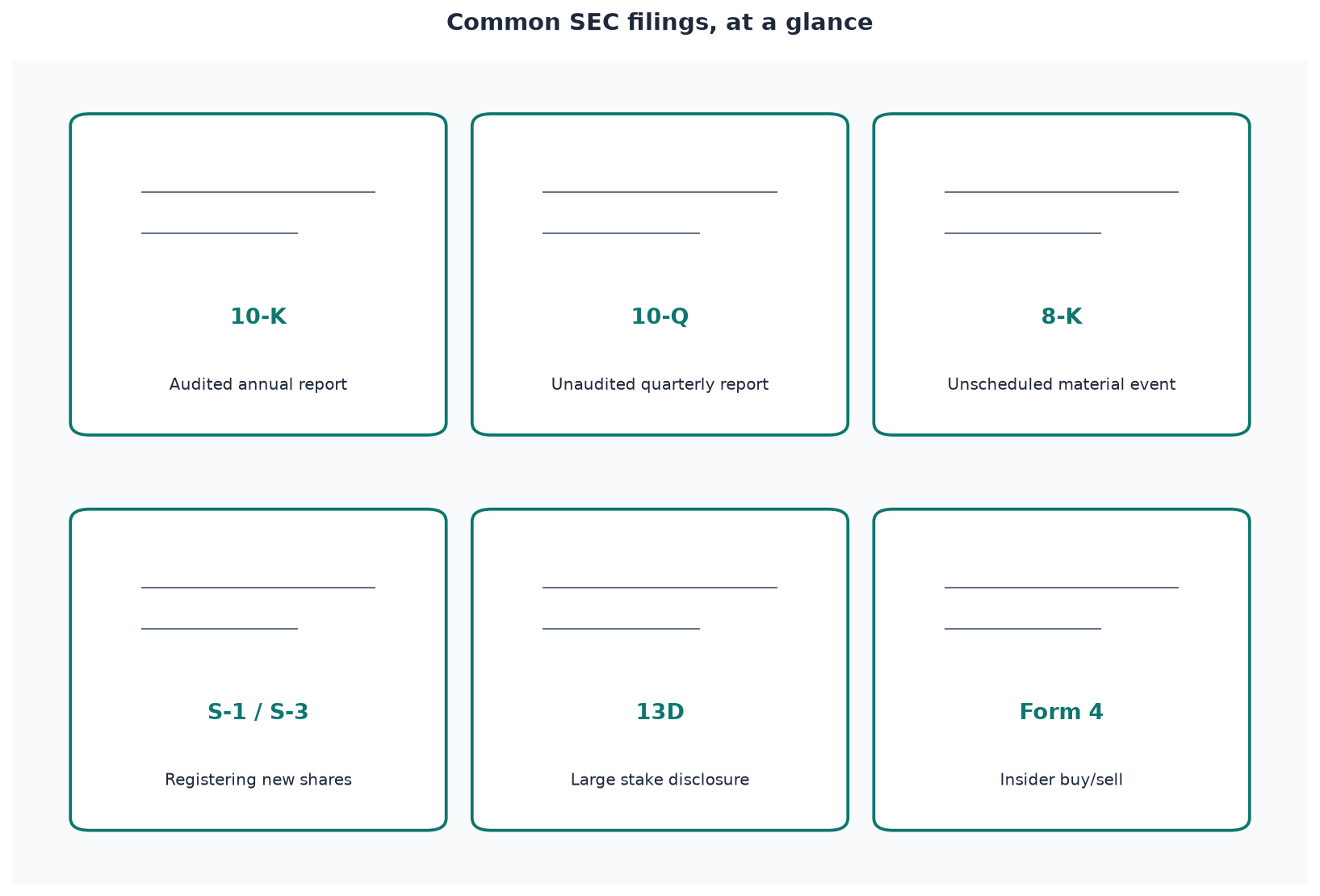
The 10-K is the audited annual report — the single most comprehensive filing a company produces, covering a full year of financial statements, a detailed description of the business, and a “risk factors” section where the company is required to disclose, in its own words, what could go wrong. The 10-Q is the unaudited quarterly version, filed three times a year (the fourth quarter is covered by the 10-K instead). The risk factors section of either filing is worth reading closely — companies are legally required to be forthright there, which makes it one of the more candid parts of an otherwise promotional set of corporate communications.
8-K: Unscheduled Material Events
An 8-K is filed within days of any unscheduled event materially affecting the company: a change in controlling ownership, a merger or acquisition, a bankruptcy filing, a CEO departure, or a securities offering. Because 8-Ks are event-driven rather than scheduled, they’re often the fastest formal disclosure of exactly the kind of news that moves a stock sharply.
S-1 and S-3: Registering New Shares
An S-1 registers shares for an initial public offering or for use in stock-option plans; an S-3 (often called a “shelf registration”) gives a company the standing right to sell additional shares into the market over the following several years without filing fresh paperwork each time. A shelf registration is a direct, early warning sign of potential future dilution: it doesn’t guarantee a company will sell more shares, but it means the door is open to do so on short notice whenever the company decides the timing suits it.
Schedule 13D: Who’s Taking a Large Stake
Any investor acquiring more than 5% of a company’s shares with an intent to influence the company must file a Schedule 13D within ten days, disclosing who they are and, often, why they took the position. This is how the market learns when an activist investor — someone intending to push for changes in strategy, management, or capital allocation — has built a meaningful stake, and the filing’s own text frequently explains the investor’s thesis directly.
Form 4: Insider Buying and Selling
A Form 4 discloses when a company insider (an officer, director, or large shareholder) buys or sells shares, filed within two business days of the transaction. A cluster of insiders buying shares with their own money is read as a meaningfully bullish signal — insiders have the best information about the company’s prospects, and buying with personal funds is a direct financial bet on the company’s future. Heavy, sustained insider selling is read with more caution, though it’s a noisier signal, since insiders sell for many ordinary reasons (diversification, taxes, scheduled plans) unrelated to any view on the company’s outlook.