
The Catalyst Hierarchy: What Actually Moves a Stock
Educational content, not investment advice. See our Disclaimer.
Why the catalyst matters once a stock is already moving
A stock scanner finds that something is moving; identifying the catalyst helps assess why, and why matters because different catalyst types carry different risk profiles, different likely durations, and different odds of reversing sharply. Treating every mover the same way — regardless of cause — discards information that’s often freely available within a few minutes of research.
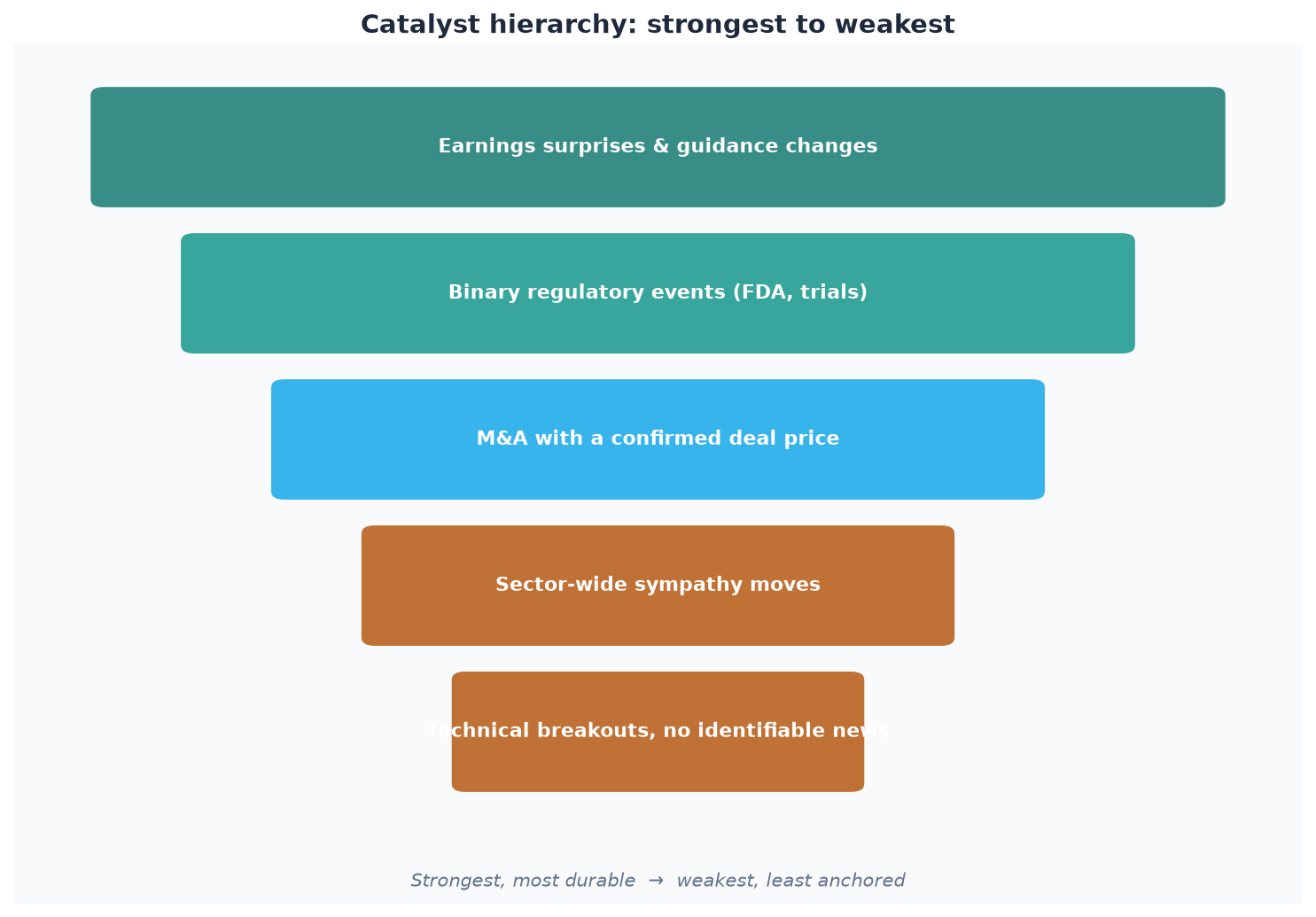
A rough hierarchy, strongest to weakest
Earnings surprises and guidance changes are among the most reliable catalysts because they represent a genuine, quantifiable change in a company’s expected cash flows — a large beat or miss versus consensus estimates routinely produces outsized, sustained volume and price movement. Binary regulatory events (FDA approvals/rejections, major clinical trial results) are similarly strong for the companies they affect, precisely because the outcome resolves genuine uncertainty in one direction. M&A activity (confirmed buyouts with a stated price) tends to pin a stock near the deal price and usually isn’t a tradeable move after the initial reaction — the uncertainty that drove volatility is already resolved. Sector-wide sympathy moves (one name in a hot theme spikes, and unrelated peers in the same theme follow on no company-specific news) are real and tradeable but inherently less durable, since the move isn’t anchored to anything company-specific. Purely technical breakouts with no identifiable news (often fueled by short covering or a large resting order getting absorbed) are the least anchored of the common categories — they can be powerful, but they carry the least informational backing, and a stock moving on no news at all is a stock that can lose its reason to keep moving at any point.
Two headline types that read as negative far more often than positive
Secondary/dilutive stock offerings generally pressure price because they increase share count and signal the company needed cash badly enough to issue new equity, often at a discount; the rare exception is an offering priced above or near the current market price on an already-strong stock, which can read as a sign of strength. Reverse stock splits by themselves are rarely a catalyst for new buying interest — they mechanically raise price per share without changing underlying value, and are sometimes a signal a company has been under price pressure for other reasons.
The practical takeaway
Before treating any mover as a serious candidate, a trader should be able to answer: what caused this, does that cause plausibly support continuation, and what would make this catalyst’s effect reverse? A move you can’t explain is a move you can’t size or risk-manage with any confidence.