
Risk Management and Position Sizing
Educational content, not investment advice. See our Disclaimer.
Why this is the foundation, not a late-stage refinement
A trader with a mediocre entry method and strict risk control can survive and improve over time. A trader with a great entry method and no risk control eventually meets a single loss large enough to erase months of gains, because an unmanaged loss has no ceiling. Risk management is what makes the learning curve survivable long enough to actually develop a working edge — it’s a precondition for improvement, not a reward for already being good.
Defining risk per trade before entering, not after
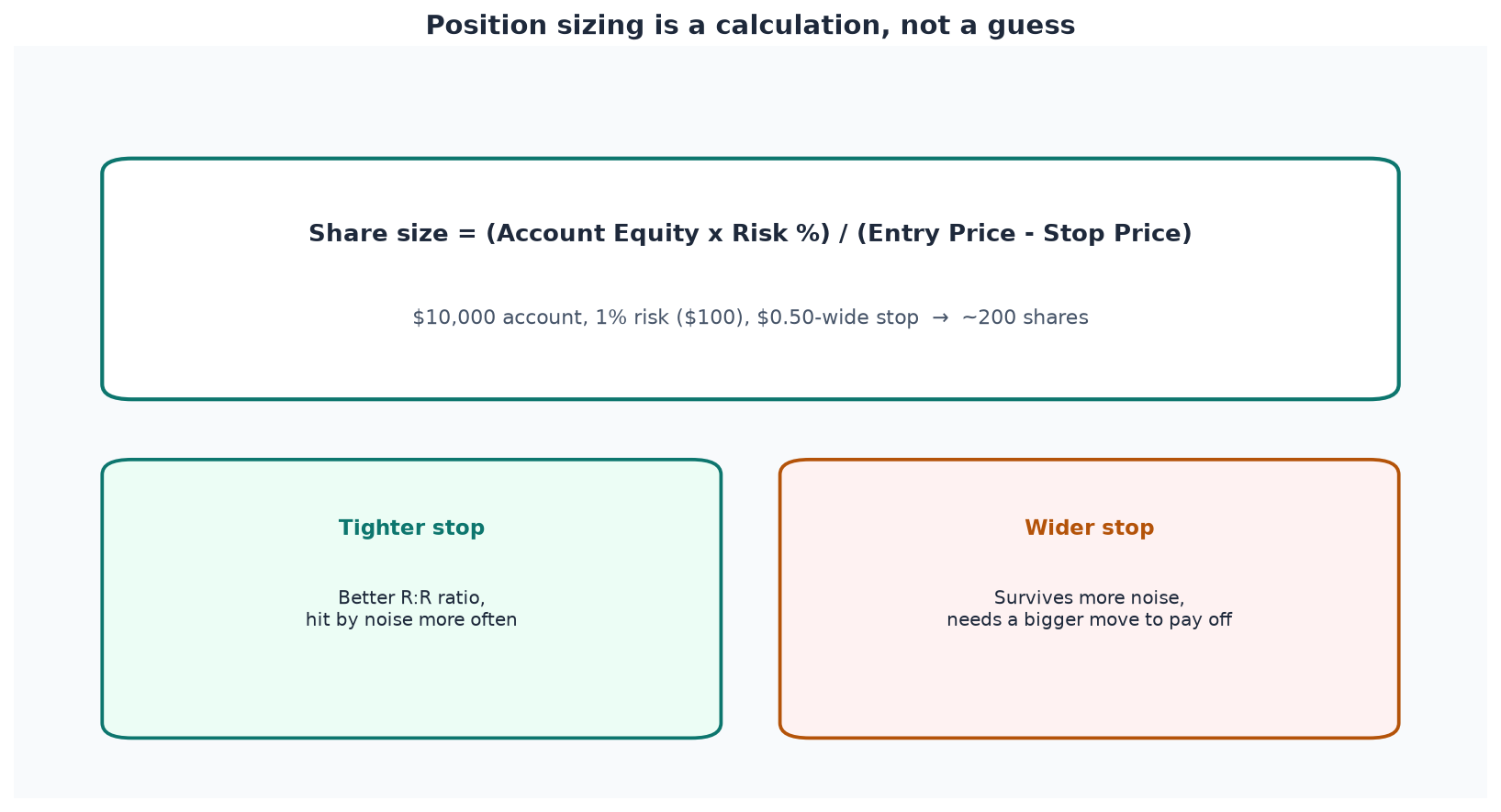
A workable risk framework starts with a maximum percentage of total account equity any single trade is allowed to lose — a common range discussed among active traders is roughly 0.5-2% of account equity per trade, though the right number depends heavily on account size, strategy, and experience. From that percentage, position size is a calculation, not a guess: (account equity × risk percentage) ÷ (entry price − stop price) = share size. A trader risking 1% of a $10,000 account ($100) with a $0.50-wide stop can size roughly 200 shares; the same risk budget with a $0.10-wide stop supports roughly 1,000 shares. The stop distance, not a round number of shares, should drive the position size.
Stops are a pre-committed decision, not a live one
A stop-loss level decided and placed before entry, based on a chart level or a fixed dollar risk, is a different psychological exercise than deciding whether to sell while already in a losing position and hoping it recovers. The latter invites the single most common and costly trading mistake: letting a small, planned loss become a large, unplanned one because exiting became an emotional decision instead of a mechanical one.
Reward-to-risk and why it matters even with a modest win rate
A trader does not need to be right most of the time to be net profitable — a strategy with a consistent 2:1 reward-to-risk ratio (risking $1 to make a plausible $2) is still profitable at a 40% win rate, before costs. The tradeoff is that reward-to-risk and win rate pull against each other: tighter stops improve the ratio but get hit by ordinary noise more often; wider stops survive more noise but demand a bigger favorable move to pay for the same risk. There’s no single correct balance — there’s a balance that matches a given strategy’s actual, measured behavior over many trades, which is why reviewing results (covered in the trading journal lesson) is inseparable from risk management.
Capital preservation beats any individual trade
The objective on any single trade is not to be right — it’s to control the cost of being wrong while remaining able to take the next trade. An account that survives a long string of small, planned losses is in a completely different position than one that takes one large, unplanned loss, even if the total dollar amount lost is similar — the first account kept its ability to compound, the second may not have.