
Reviewing Your Trades: Building a Trading Journal
Educational content, not investment advice. See our Disclaimer.
Why tracking trades isn’t optional
Without a record of what was actually done — entry reason, setup type, size, result — a trader is relying on memory, which is selectively biased toward the trades that felt dramatic (the huge winner, the painful loss) and tends to blur the larger number of unremarkable trades that actually carry the statistical signal. A trading journal converts a blur of individual experiences into data that can be sorted, filtered, and analyzed, which is the only reliable way to find out what’s actually working.
What a useful journal entry captures
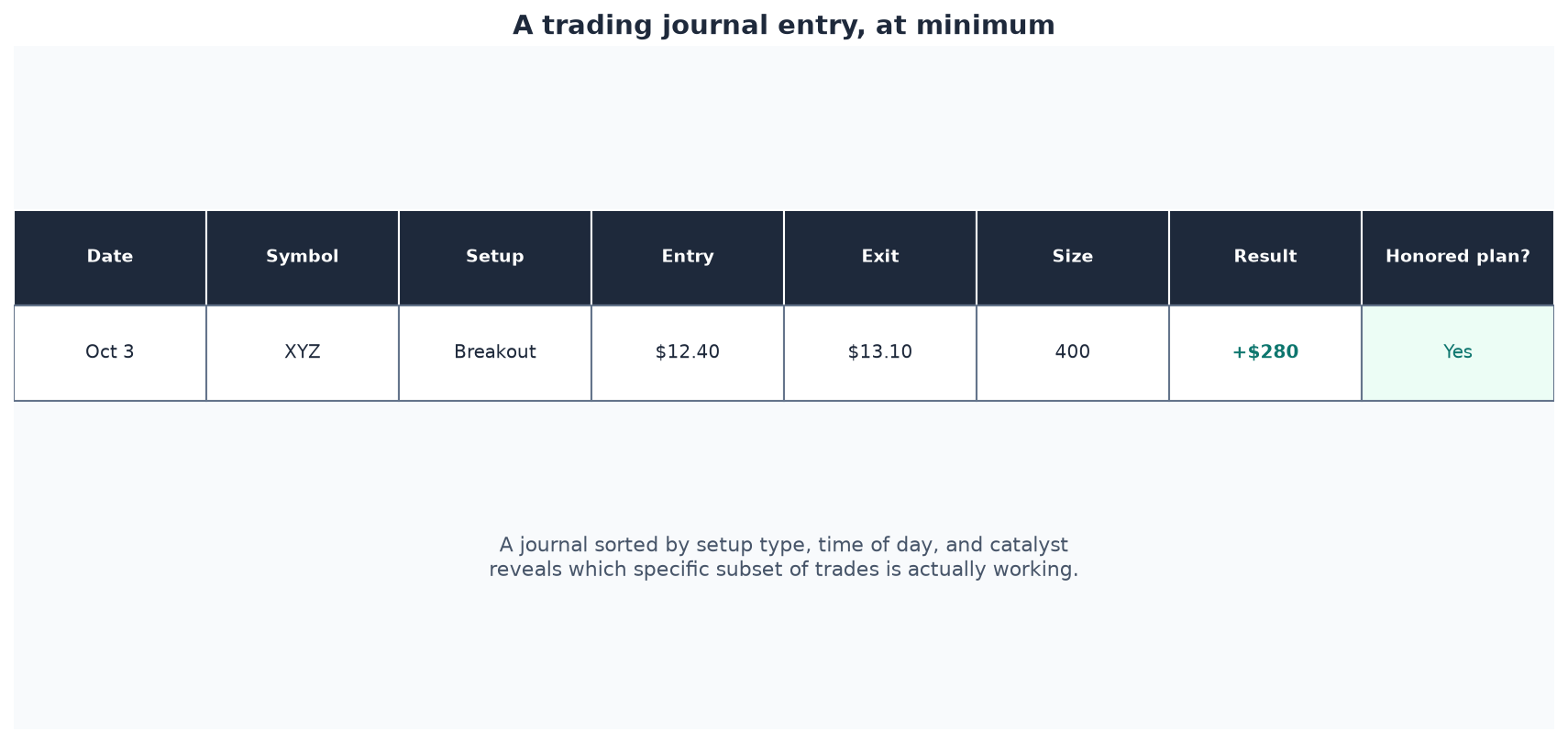
At minimum: the date and time, the symbol, entry and exit price, share size, the setup or strategy type (e.g. a breakout off consolidation, a dip-buy, a reversal), the catalyst if one was identified, and a brief note on execution quality — was the entry and exit close to planned, or did emotion override the plan partway through? Many traders also tag trades with simple categorical labels (by setup type, by time of day, by catalyst type, by whether a stop was honored as planned) specifically so results can later be filtered and compared across those categories.
The real value: finding the subset that actually works
A review process that only produces an aggregate win rate and average P&L is throwing away most of the useful information. The more valuable analysis slices results by category: performance on breakout setups versus dip-buy setups, performance trading the first hour versus midday, performance on earnings catalysts versus purely technical moves. It is common and genuinely useful to discover that overall results are mediocre while one specific, well-defined subset of trades is consistently profitable — and that the practical path forward is trading that subset more and the rest less, not abandoning the whole approach.
Reviewing promptly, while the decision context is still available
A trade reviewed the same day, while the reasoning behind each decision is still fresh, produces far more useful notes than one reconstructed from a broker statement days or weeks later, when the specific thought process at each decision point has been forgotten. A short, consistent daily habit of logging trades is more valuable than an occasional deep, retrospective analysis.
What review is not
Reviewing trades is not the same exercise as berating yourself for a losing day, and conflating the two tends to make a trader avoid the habit altogether, precisely when it’s most needed. The useful version of review is closer to a neutral audit: what actually happened, what the plan was, where they diverged, and what that suggests changing — without treating every loss as a personal failure or every win as proof of skill.