
Large-Cap vs. Small-Cap Trading: Two Different Games
Not every stock trades the same way, and treating a $3 billion-market-cap biotech the same way you’d treat a $2 trillion mega-cap is a fast way to lose money for reasons you don’t understand. Market capitalization — share price times shares outstanding — splits the market into rough tiers: small-cap (roughly $300 million to $2 billion), mid-cap ($2–10 billion), and large-cap (above $10 billion, with mega-caps like Apple or Microsoft running into the trillions). The tier a stock sits in changes almost everything about how it behaves intraday.
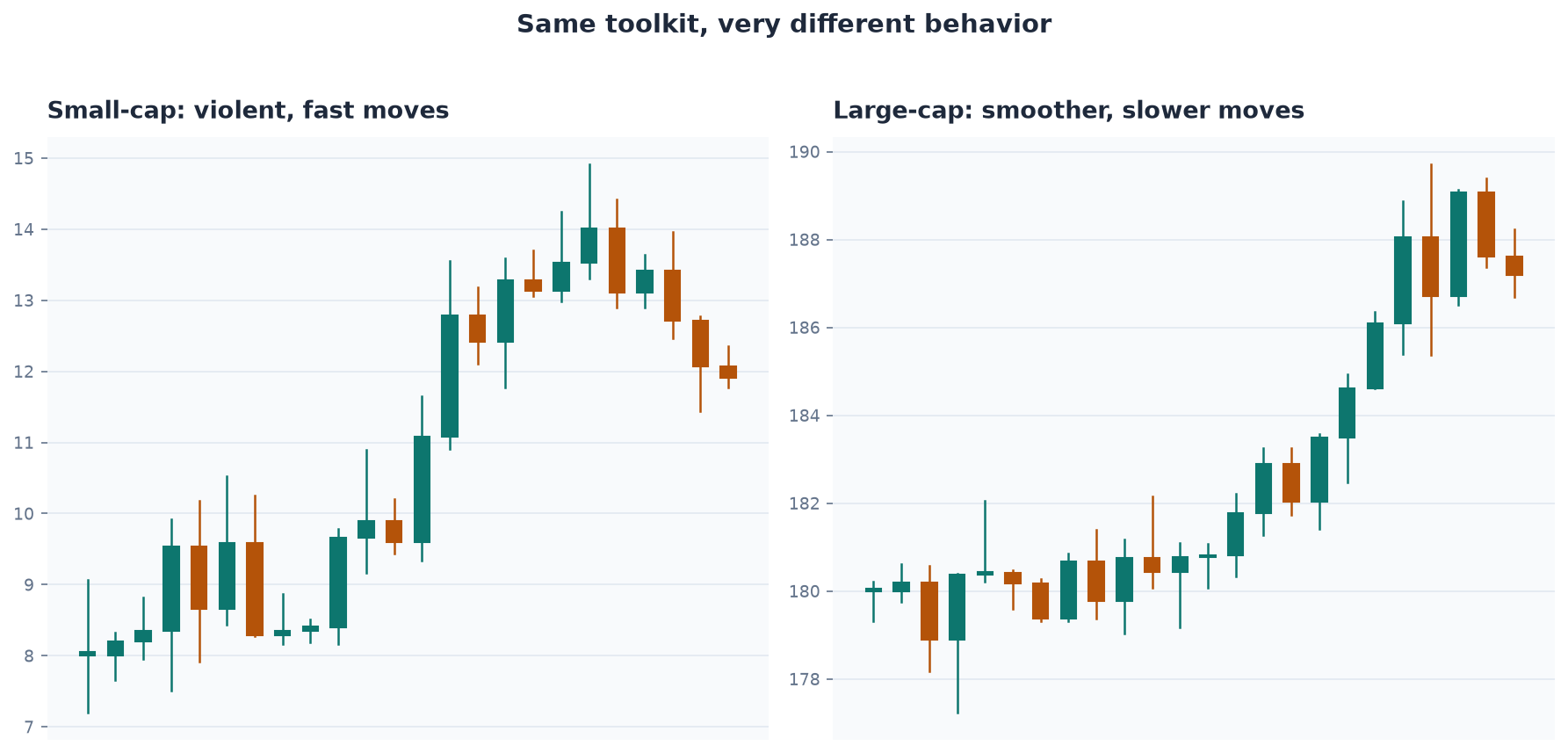
Why Small-Caps Move Fast
Small-cap stocks, especially low-float names trading under $10-$20, can move 20%, 50%, even 200% in a single session. The mechanism is simple supply and demand: when the number of shares actually available to trade (the float) is small and a catalyst — earnings, an FDA decision, a contract announcement — pulls in a wave of buyers, there aren’t enough sellers to absorb the demand without price moving violently. This is exactly the dynamic a stock’s catalyst and liquidity profile describe (see the Catalyst Hierarchy and Scanning lessons). The upside is outsized profit potential in minutes. The downside is the same violence working against you: spreads widen, slippage grows, and a thin stock can gap through a stop-loss level with no fills at your price. These names reward speed and punish hesitation.
Why Large-Caps Move Differently
Large-cap and mega-cap stocks have enormous share counts and are heavily owned by institutions — pension funds, index funds, mutual funds — whose trading desks execute positions worth hundreds of millions of dollars without materially moving the price in a single transaction. That depth of liquidity is exactly why large-caps behave more smoothly: moves tend to unfold over hours rather than seconds, technical levels (support, resistance, moving averages) tend to hold with more consistency because so many participants are watching the same levels, and slippage on entries and exits is minimal. The trade-off is that the percentage moves are smaller — a 3% move in a mega-cap in a day is a big deal, where a small-cap can do that in a minute.
Matching the Instrument to the Trader
Neither tier is objectively “better” — they suit different temperaments and constraints. Small-cap trading rewards fast decision-making, comfort with wider stops in percentage terms, and the discipline to size positions down because of the volatility. Large-cap trading rewards patience, a willingness to let a position develop over a longer intraday window, and the discipline to not force entries just because nothing seems to be happening. A trader prone to overtrading often does better in large-caps, where there are simply fewer tradeable setups per day. A trader who thrives on fast pattern recognition and rapid execution may find large-caps frustratingly slow.
Capital Requirements Differ Too
Because large-caps trade in high dollar amounts per share, position sizing in shares looks smaller for the same dollar risk — which is a liquidity benefit, not a barrier to entry. A trader can scale a large-cap strategy with a small account by trading fewer shares, same as with any instrument; the Pattern Day Trader rule and account minimums covered earlier in this course apply equally to both tiers. What changes is not account size requirements but the character of the trades themselves.
The Takeaway
Before choosing a watchlist focus, be honest about which environment fits your personality and risk tolerance. Trading small-caps with a large-cap mindset (expecting slow, orderly moves) gets you run over. Trading large-caps with a small-cap mindset (expecting explosive moves every few minutes) leads to overtrading a market that isn’t giving you anything. The strategies in this course — catalyst screening, risk management, tape reading — apply to both; what differs is the pace and the sizing.