
Order Types and Order Entry Mechanics
Educational content, not investment advice. See our Disclaimer.
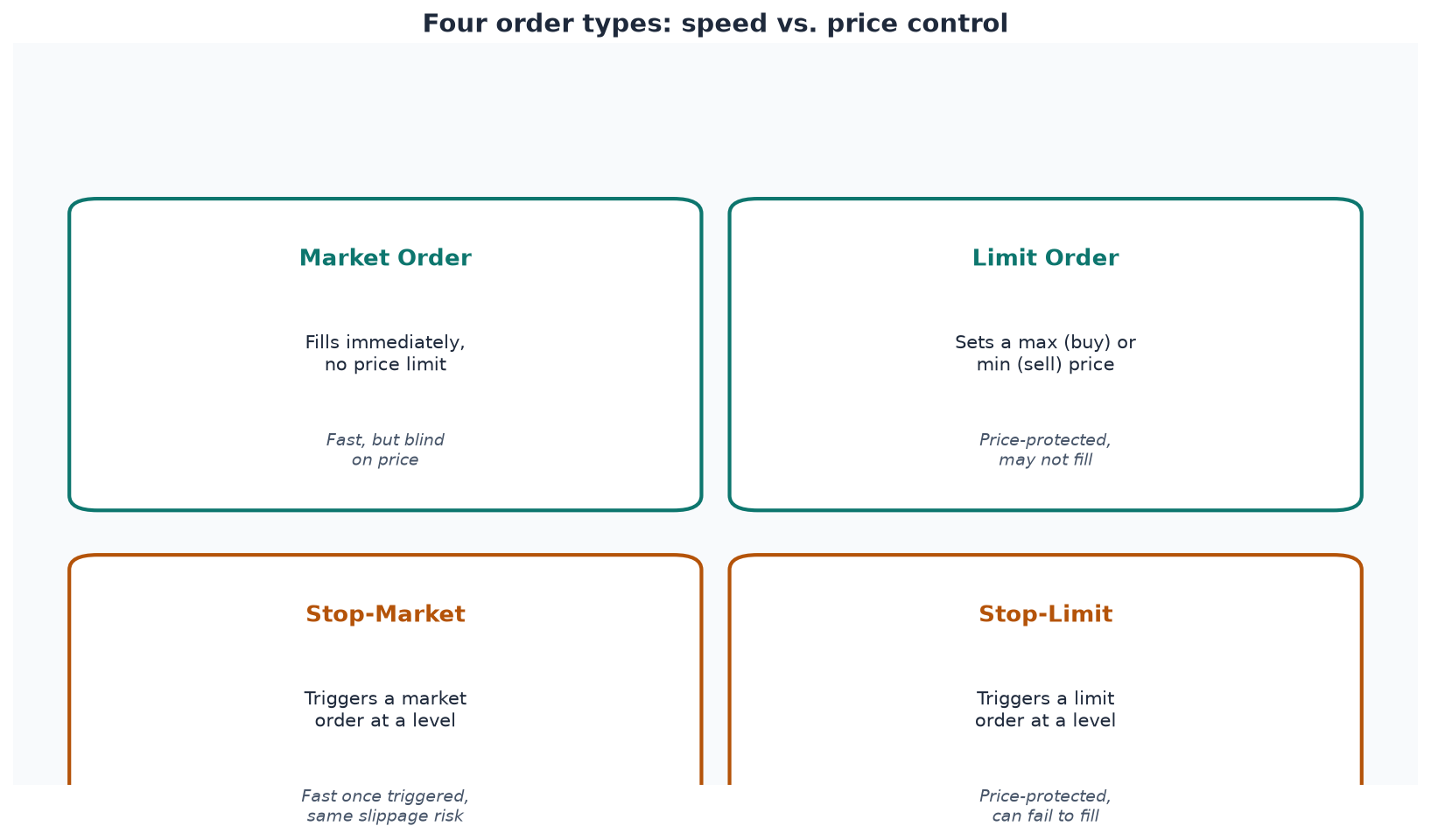
Market orders: fast, but blind on price
A market order fills immediately at whatever price is currently available, with no price limit. On a stable, heavily traded stock the risk is small. On a fast-moving or thinly traded one, the fill price can differ meaningfully from the price you saw a second earlier — this gap between expected and actual fill price is called slippage, and it’s the main reason active traders are cautious with market orders on volatile names.
Limit orders: control price, risk not filling
A limit order sets the worst price you’re willing to accept — a maximum for a buy, a minimum for a sell. If the current market price already satisfies your limit, it fills immediately (this is sometimes called a marketable limit order); if not, it waits, and may never fill if the price moves away. Traders commonly set a limit a few cents beyond the current price (an “offset”) precisely to behave like a market order in calm conditions while still capping the worst-case fill in a sudden spike.
Stop orders: a conditional trigger, not a guarantee
A stop order becomes active only once the price crosses a trigger level you set — it does nothing until then. There are two flavors: a stop-market order, which becomes a market order the instant the trigger is hit (fast, but subject to the same slippage risk as any market order); and a stop-limit order, which becomes a limit order at the trigger (price-protected, but can fail to fill entirely if the price gaps straight through your limit in a fast decline). Neither type guarantees the exact trigger price as your fill price — in a fast market, actual fills can land meaningfully worse than the stop level. A trailing stop automatically moves the trigger level as the price moves favorably, locking in more profit as a trade works, at the cost of getting stopped out on normal pullbacks before a bigger move completes.
Order routing, briefly
Orders reach the market through an electronic pathway (an ECN or exchange route). “Smart routing,” offered by default at many retail brokers, picks a route automatically and is usually the slower, lower-cost option; “direct routing” lets the trader pick a specific exchange or ECN and is typically faster, sometimes at a small per-share fee. For most buy-and-hold or swing-oriented trading, the difference is immaterial. For fast intraday trading on volatile stocks, execution speed differences of even a fraction of a second can matter.
A regulatory detail that trips up beginners
Market orders only execute during regular trading hours (9:30 a.m.–4:00 p.m. Eastern in the US). In the pre-market (4:00–9:30 a.m.) and after-hours (4:00–8:00 p.m.) sessions, only limit orders are accepted, specifically because thin liquidity in those windows makes market orders unacceptably risky for retail traders — a regulatory safeguard, not a platform quirk.
Why this matters before anything else
Every strategy discussed later in this course assumes you already understand which order type you’re using and why. Getting this mechanic wrong — sending a market order into a fast-moving, thin stock, for instance — can turn a correct read of the market into an avoidable loss purely through execution mechanics, independent of whether the underlying trade idea was sound.