
Account Types and the Pattern Day Trader Rule
Educational content, not investment, legal, or tax advice. See our Disclaimer.
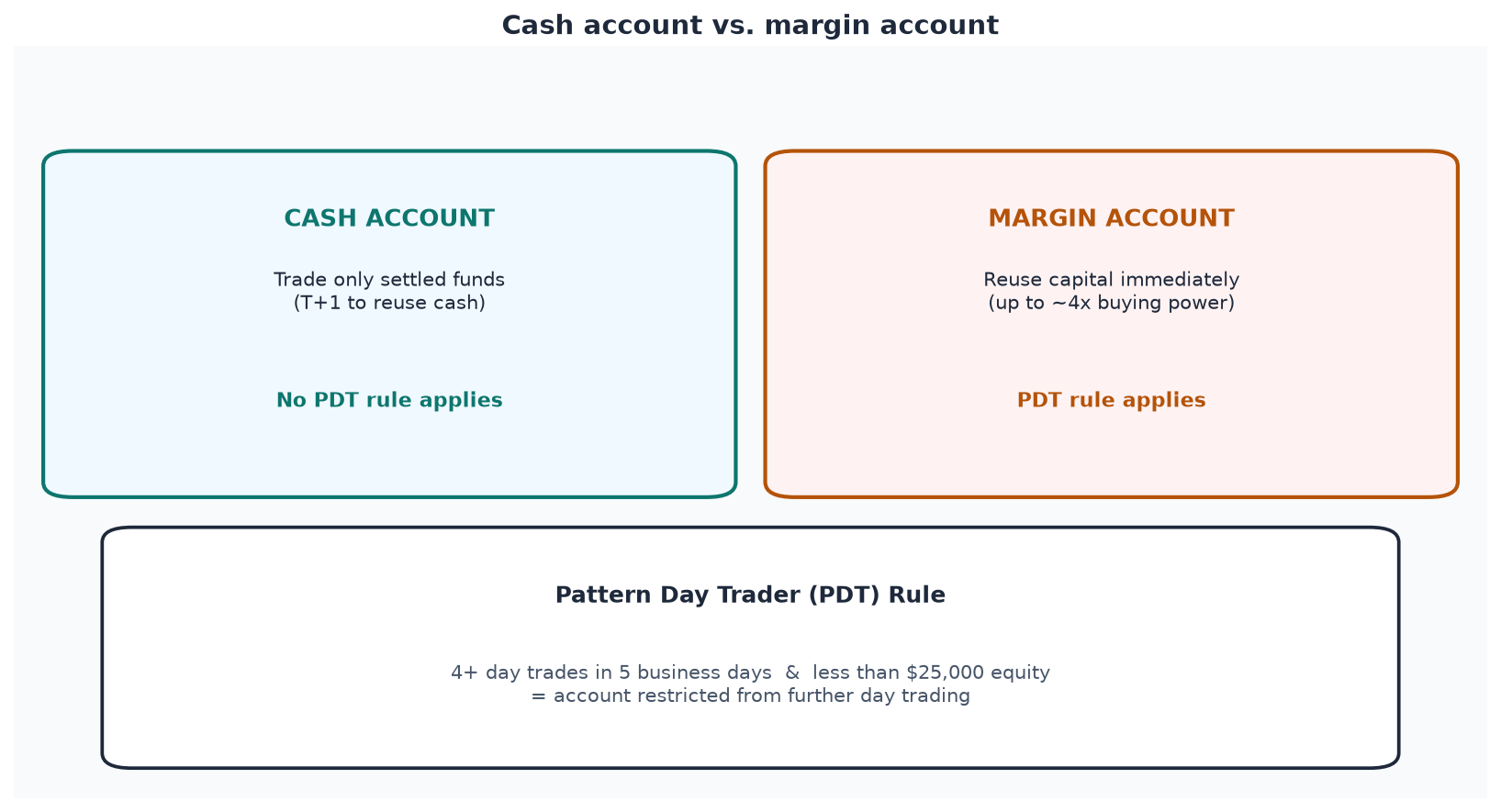
Cash accounts vs. margin accounts
A cash account only lets you trade with settled funds. As of May 2024, US equity trades settle on a T+1 basis (one business day after the trade), down from the previous T+2 standard — so a cash account’s funds become available to reuse the next business day after a sale, not instantly. A margin account lets you reuse the same capital immediately without waiting for settlement, because the broker extends you credit against your deposited funds, typically up to 4x your account equity for day-trading buying power. That buying power is a double-edged tool: a position sized with leverage amplifies both gains and losses by the same multiple relative to your account equity — it does not change the underlying stock’s percentage move, only how much of your account that move represents.
The Pattern Day Trader (PDT) rule
FINRA’s Pattern Day Trader rule requires a minimum of $25,000 in equity in a margin account for any trader who executes four or more day trades within five business days, using more than 6% of their total trades in that window as day trades. Fall under that definition with less than $25,000, and the account gets restricted from further day trading until equity is brought back above the threshold. This is a hard regulatory constraint, not a broker preference — it applies to margin accounts at all US-regulated brokers.
What traders with less than $25,000 actually do
There is no way around the rule in a US margin account below the threshold. Realistic paths include: trading fewer than four day trades per five-day window (holding positions overnight instead, which converts a trade into a swing trade with its own overnight risk); using a cash account, which has no PDT restriction but requires waiting for each trade’s settlement before reusing that specific cash; or building the account slowly within the three-trade-per-week constraint until it clears $25,000. There is no shortcut that removes real capital or real risk from the equation.
A word on retirement accounts
Some traders eventually also trade inside a tax-advantaged retirement account (in the US, a Traditional or Roth IRA). These accounts can offer settlement-based margin in some cases but never leverage, since a broker cannot let a retirement account go into debt. Whether and how to use a retirement account for active trading is a decision that depends heavily on individual tax circumstances — this is a general description, not a recommendation, and a licensed tax professional is the right resource for a specific situation.
Choosing your instrument
This course focuses on US equities (individual stocks), which is the most accessible starting instrument: no expiration dates, no options-specific mechanics, and the most straightforward risk profile to learn position sizing on. Instruments like options and futures add real complexity (time decay, assignment risk, contract mechanics) that are worth learning only after the fundamentals in this course are solid.