
Simulated Trading: Why It Matters and How Long It Should Last
Educational content, not investment advice. See our Disclaimer.
What a simulator is actually good for
A trading simulator lets a trader practice reading charts, Level 2, and Time & Sales, and executing a strategy’s mechanics (order entry, position sizing, stop placement) without risking capital. For the specific purpose of building pattern recognition and order-entry muscle memory, repeated simulator practice has genuine value and should generally come before any real-money trading, not after.
What a simulator cannot teach
A simulator does not replicate two things that matter enormously once capital is actually at risk. First, emotion: fear of loss, the urge to revenge-trade, and overconfidence after a win are muted or absent when nothing real is being risked, which means a trader can look highly skilled and disciplined in simulation and then struggle to apply the same rules the moment real money changes the stakes. Second, realistic execution: a simulator frequently fills orders at displayed prices regardless of actual available liquidity, which can understate the slippage a trader would experience on a real order against thin order-book depth, especially at larger size. Both gaps mean strong simulator results are a necessary but not sufficient signal of readiness.
A workable transition framework
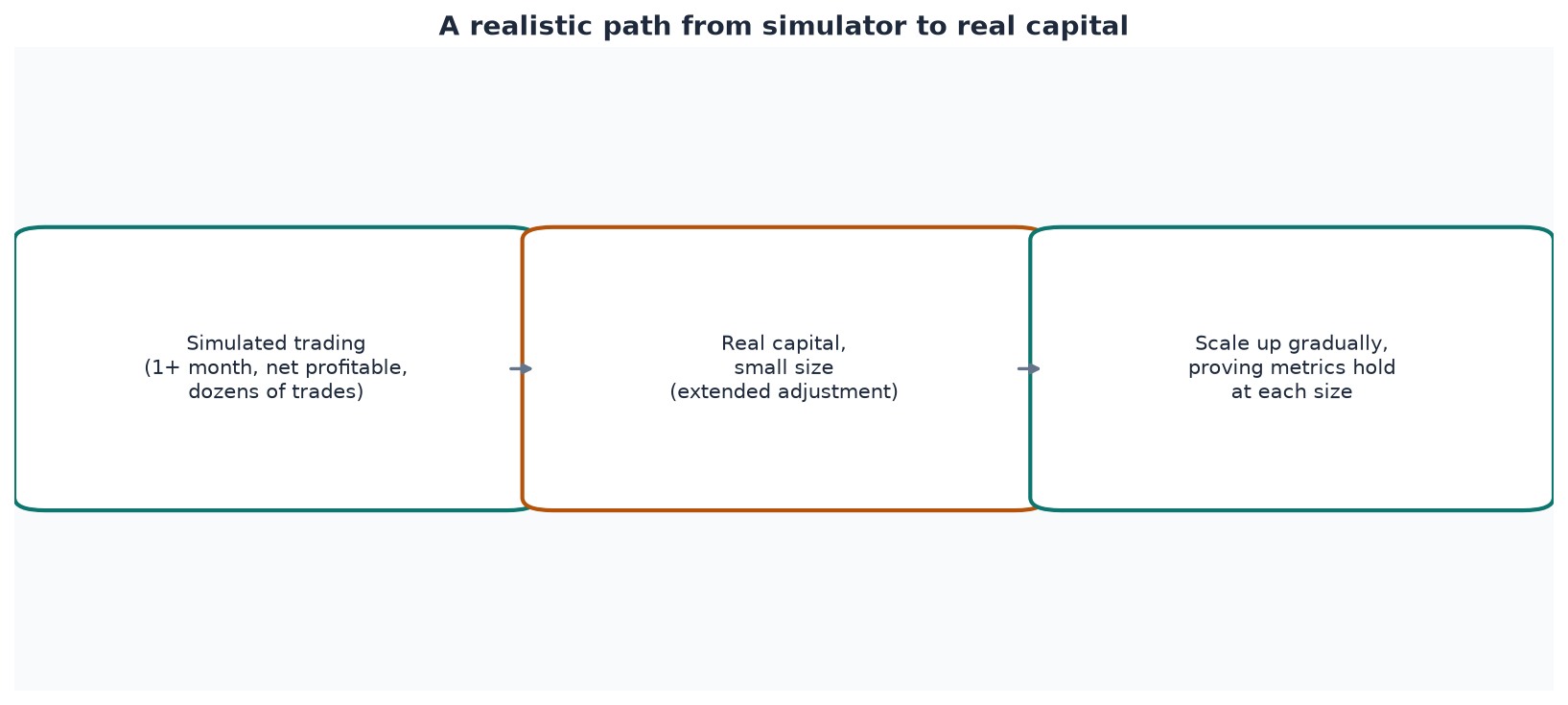
A commonly cited benchmark among active traders is at least one month of simulated trading that is both net profitable and built on a reasonable sample size (on the order of dozens of trades, not two or three), not just a single lucky stretch. On transitioning to real capital, starting with a small position size (a small fraction of the size used in simulation) for an extended adjustment period, and tracking whether the same accuracy and reward-to-risk metrics hold up under real emotional pressure, is a more reliable test of readiness than either the simulator results alone or a trader’s own confidence.
A concrete failure pattern worth knowing in advance
A trader who spends an extended period in simulation building an excellent track record, then jumps directly to large real-money positions without an intermediate small-size adjustment phase, commonly struggles specifically because the emotional and execution gaps described above both hit at once, at full size, with nothing to buffer the transition. Scaling up gradually — proving metrics hold at each size level before increasing further — costs some speed but meaningfully reduces this risk.
Simulation has a sell-by date
Extended simulator practice has diminishing and eventually negative returns: a trader who stays in simulation indefinitely, well past the point of basic competence, is deferring the harder (but necessary) work of adapting to real execution and real emotion, and may be using the comfort of risk-free trading as an avoidance strategy without recognizing it as such. The practical goal of this stage is proving mechanical competence and discipline, not creating conditions to stay there forever.