
Stop Losses and the Discipline to Honor Them
Educational content, not investment advice. See our Disclaimer.
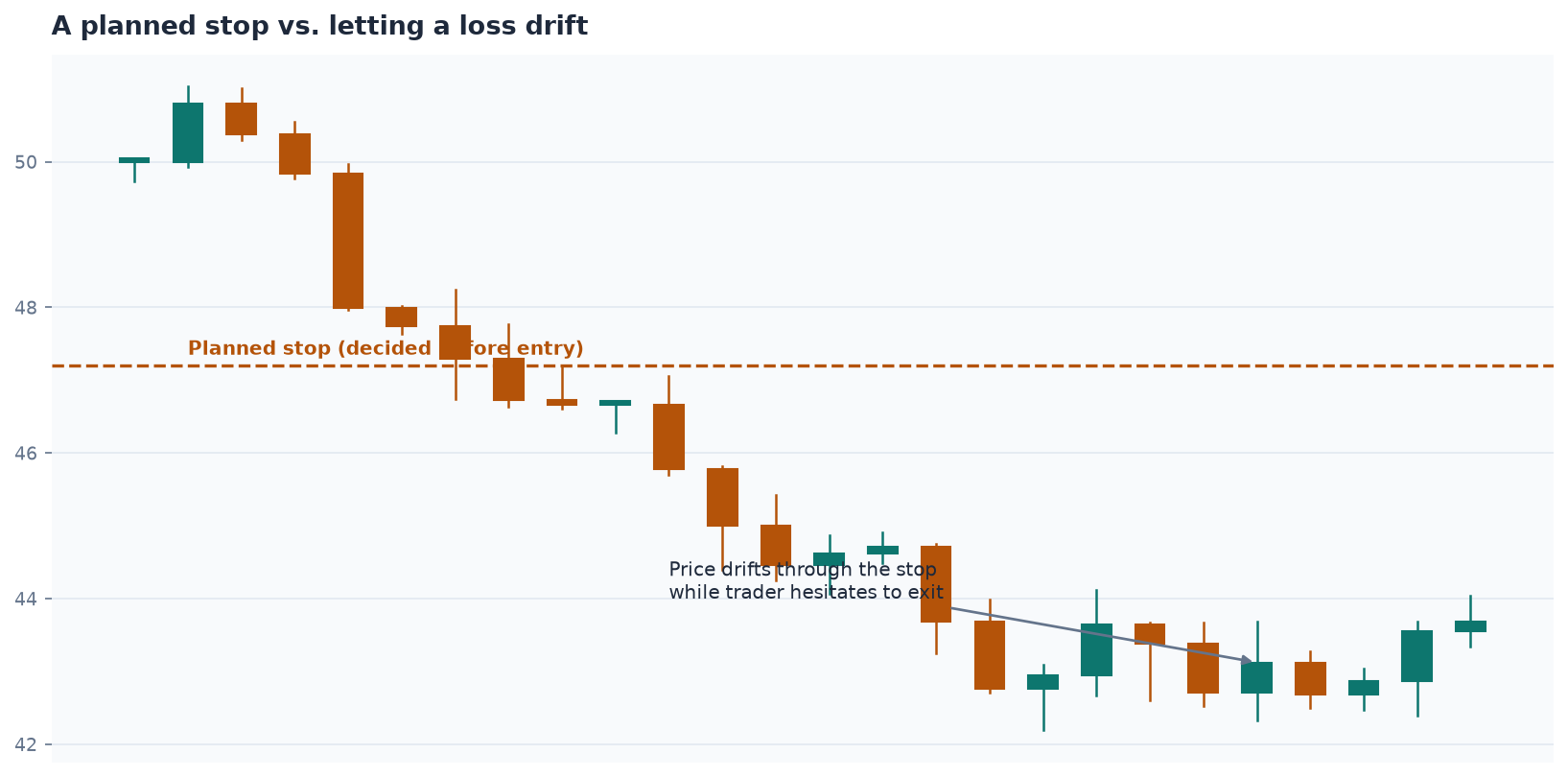
The stop decided beforehand is a different decision than the stop decided while losing
Deciding a stop-loss level before entering, anchored to a chart level or a fixed dollar risk, is a calm, unemotional calculation. Deciding whether to exit while already holding a losing position is an entirely different psychological act — it happens under the influence of hope, sunk-cost thinking, and the discomfort of admitting a trade isn’t working. The single most common and costly mistake in active trading is letting a small, pre-planned loss drift into a large, unplanned one because the exit became a live emotional negotiation instead of a mechanical rule applied without debate.
Why traders skip their own stops
The pattern is consistent enough to be almost universal: a position moves against the trader, the stop level approaches, and instead of exiting, the trader reasons that the stop is “too close” to the current price, that the stock will probably bounce, or that averaging down would improve the entry. Each of these may occasionally be correct on any single trade — which is precisely what makes the habit dangerous. A decision rule that works 90% of the time but produces a catastrophic loss the other 10% can still be a losing strategy overall, because the bad outcomes aren’t capped the way a respected stop caps them.
A hard constraint most traders underestimate: stop hunting and fast markets
On lower-liquidity, high-volatility stocks, a visible large stop order can act like a magnet — other market participants are aware that a cluster of stops sitting at an obvious technical level (a round number, a recent low) creates predictable selling pressure if triggered, and price can be pushed toward that level specifically to trigger it. This argues for placing stops at a level that reflects genuine technical invalidation of the trade thesis, not simply a few cents below entry, and for keeping position size reasonable relative to the stock’s typical volatility rather than relying on an extremely tight stop to control risk on an oversized position.
A simple test for whether a stop is doing its job
A stop level should answer one question clearly: at what price is the original reason for entering this trade no longer true? If a trader can’t articulate why a specific price invalidates the setup, the stop is arbitrary and will be easy to rationalize away under pressure. A stop tied to a concrete technical or risk-based reason is measurably easier to honor than one chosen simply because it felt acceptable at entry.
Discipline is a built habit, not a fixed trait
Treating a stop as non-negotiable before entering — sometimes literally placing the stop order at the same moment as the entry order, rather than planning to add it mentally later — removes the decision from the moment of maximum emotional pressure. Traders who build this as a mechanical habit during lower-stakes practice (see the lesson on simulated trading) have a meaningfully easier time maintaining it once real money and real emotion are involved.