
Economic Moats and Competitive Position
An economic moat is a durable competitive advantage that protects a company’s profits from competitors over long stretches of time — a term popularized in value-investing circles as a metaphor for the water-filled trench that protected a medieval castle. Identifying whether a company has one, and how wide it is, is one of the more qualitative but genuinely important parts of fundamental analysis, since even a perfectly healthy balance sheet today says little about a business’s staying power a decade out.
Common Sources of a Moat
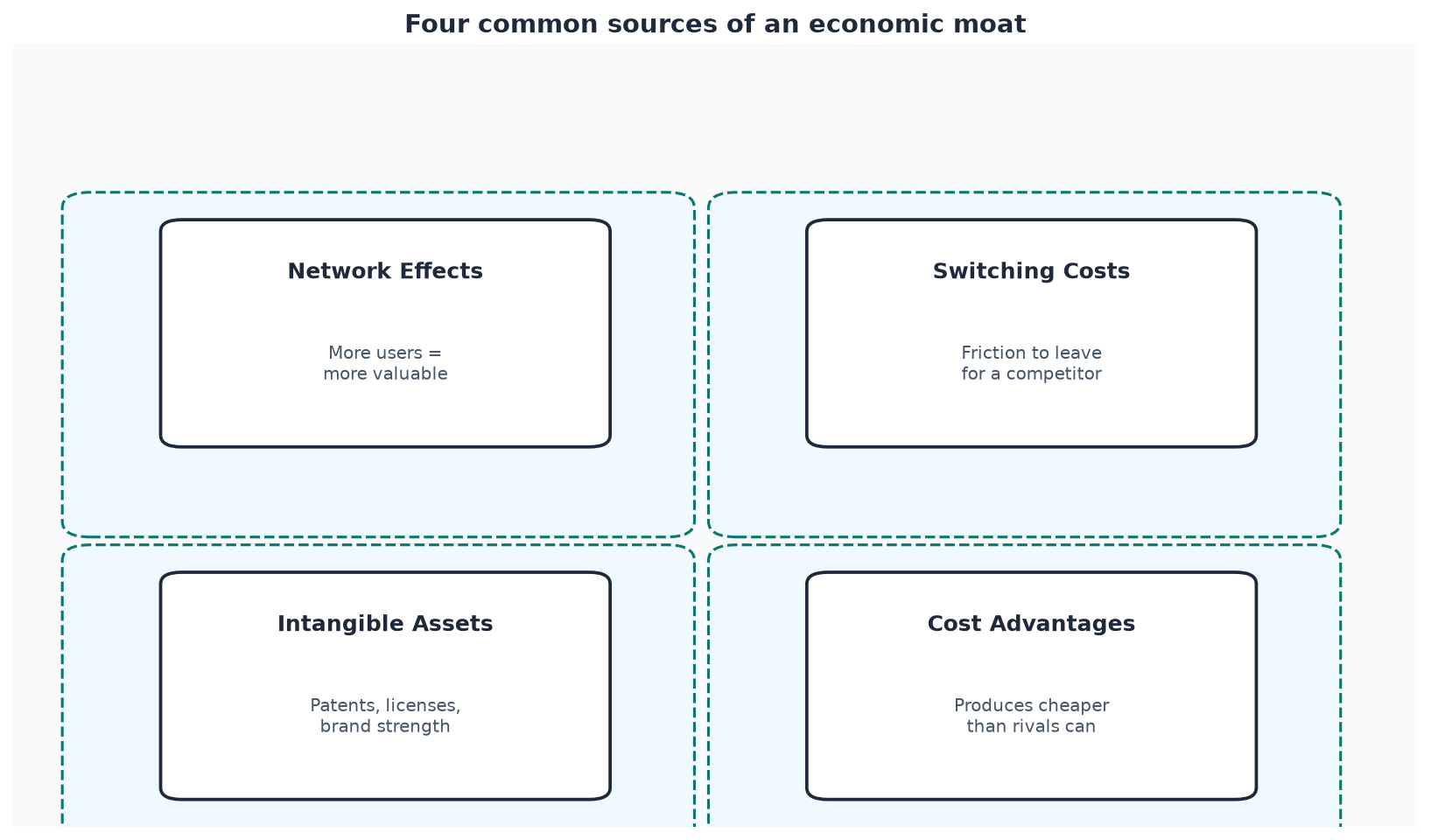
Network effects occur when a product becomes more valuable as more people use it — a marketplace or social platform where buyers attract sellers and sellers attract buyers is hard for a new entrant to dislodge, because a competitor has to attract both sides simultaneously with none of the existing density. Switching costs describe the friction (financial, operational, or simply habitual) a customer faces leaving a product for a competitor’s — enterprise software embedded deep in a company’s operations, or a bank account tied to years of automatic payments, both carry real switching costs that keep customers in place even when a cheaper alternative exists. Intangible assets — patents, regulatory licenses, brand strength — can legally or practically block competitors from replicating a product. Cost advantages arise when a company can produce at a lower cost than competitors through scale, unique access to a resource, or a superior process, letting it either undercut rivals on price or earn a fatter margin at the same price. High switching costs combined with scale — a utility that owns the only power lines in a region, for instance — can create a near-complete local monopoly that’s extremely difficult for a rival to challenge at all.
Moats Erode
No moat is permanent. Technology shifts, regulatory changes, and new entrants with genuinely novel approaches have eroded moats that looked unassailable for decades. Assessing a moat isn’t a one-time judgment — it’s an ongoing question of whether the sources of advantage identified are strengthening, holding steady, or eroding as competitors, technology, and customer behavior evolve.
Why This Matters for Valuation
A company with a wide, durable moat can often sustain higher margins and more predictable growth for longer, which is part of why the market is often willing to pay a higher valuation multiple for it relative to a company with the same current financials but no clear competitive protection. Two companies posting an identical P/E and an identical growth rate today can deserve meaningfully different valuations once the durability of each one’s advantage is factored in.