
Becoming a Trader: What the Job Actually Requires
Educational content. This is not investment advice, not a recommendation to trade, and not a promise of results. See our Disclaimer.
Start with the honest base rate
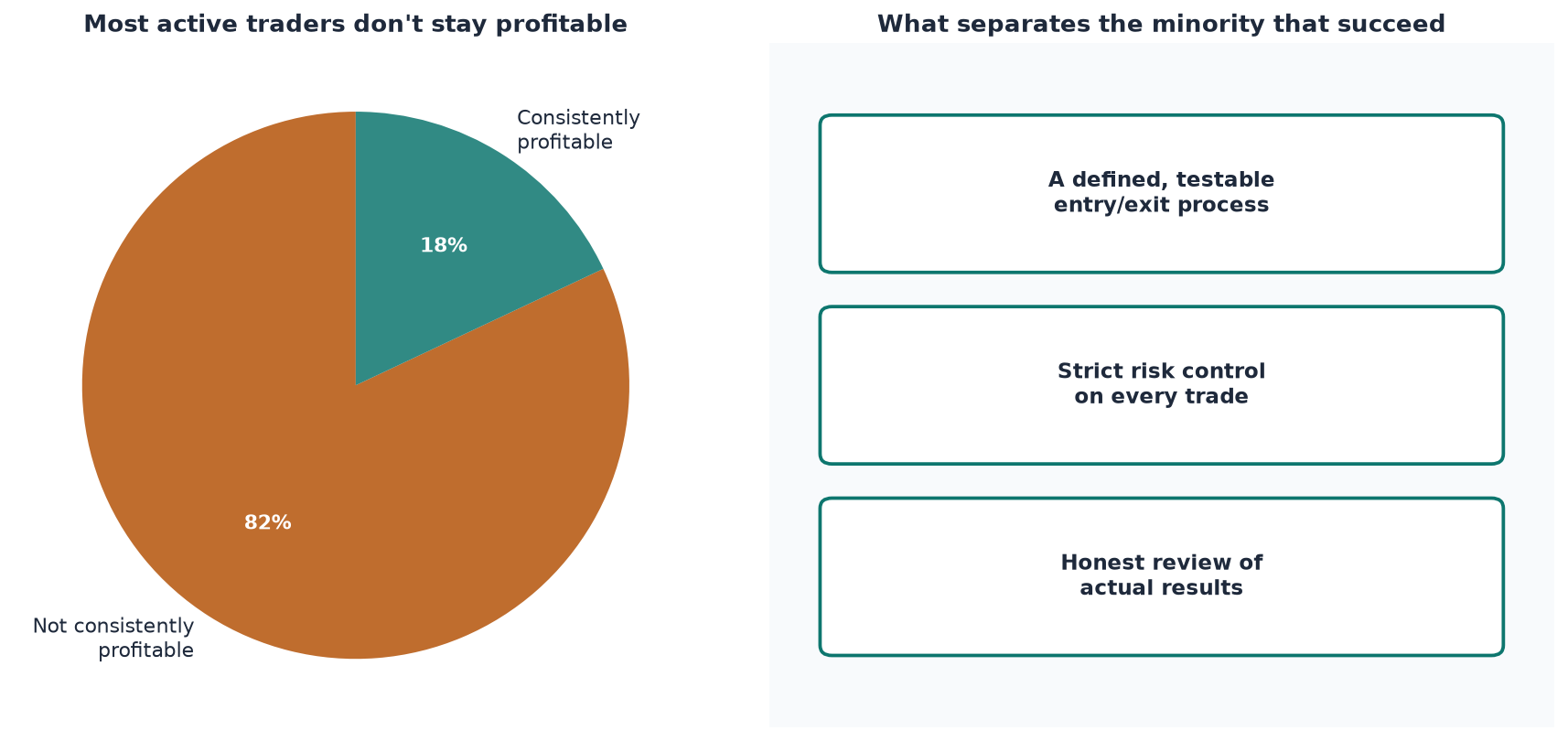
Most people who attempt active trading do not end up consistently profitable. This isn’t a scare tactic — it’s the single most useful fact to internalize before putting real money at risk. Regulators and independent studies on retail trading accounts consistently find that a large majority of active traders lose money over time, and only a small minority sustain profitability for years, not months. Treating trading as a skill with a difficult, multi-year learning curve — rather than a shortcut to income — is the first realistic adjustment most beginners need to make.
What separates the minority that succeeds
It is almost never raw prediction ability. The traders who last tend to share three traits: a defined, testable process for entering and exiting positions; strict risk control that caps the damage of being wrong (because being wrong is going to happen often, even to good traders); and a habit of reviewing their own results honestly instead of only the trades that worked. None of those three require predicting the market correctly more than half the time — they require controlling the cost of being wrong and compounding the edge of being right.
Three things beginners underestimate
Capital. Trading with money you cannot afford to lose changes your decision-making under pressure, usually for the worse. Undercapitalized accounts also run into structural constraints (see the next lesson on account types and the Pattern Day Trader rule) that have nothing to do with skill.
Time to competence. Reading a few articles or watching a few videos does not substitute for screen time spent on simulated or very small real positions, reviewed honestly. Expect months, not days, before a process stabilizes.
Psychological cost. Watching your own money move in real time triggers responses — fear, euphoria, revenge trading after a loss — that no amount of reading prepares you for until you’ve felt them. Simulated trading helps with mechanics; it does not fully replicate this.
What this course is, and what it is not
This course distills a disciplined framework for thinking about selection, mechanics, risk, and psychology in short-term trading. It describes a way of approaching the problem — it does not sell a signal service, a guaranteed strategy, or a shortcut around the learning curve above. Every lesson that follows builds toward being able to construct and test your own trading plan, not toward copying someone else’s trades.
Where to go next
The next lesson covers account types, the regulatory constraints that apply to pattern day trading in the US, and how those constraints shape realistic account-size decisions.