
What Is Fundamental Analysis
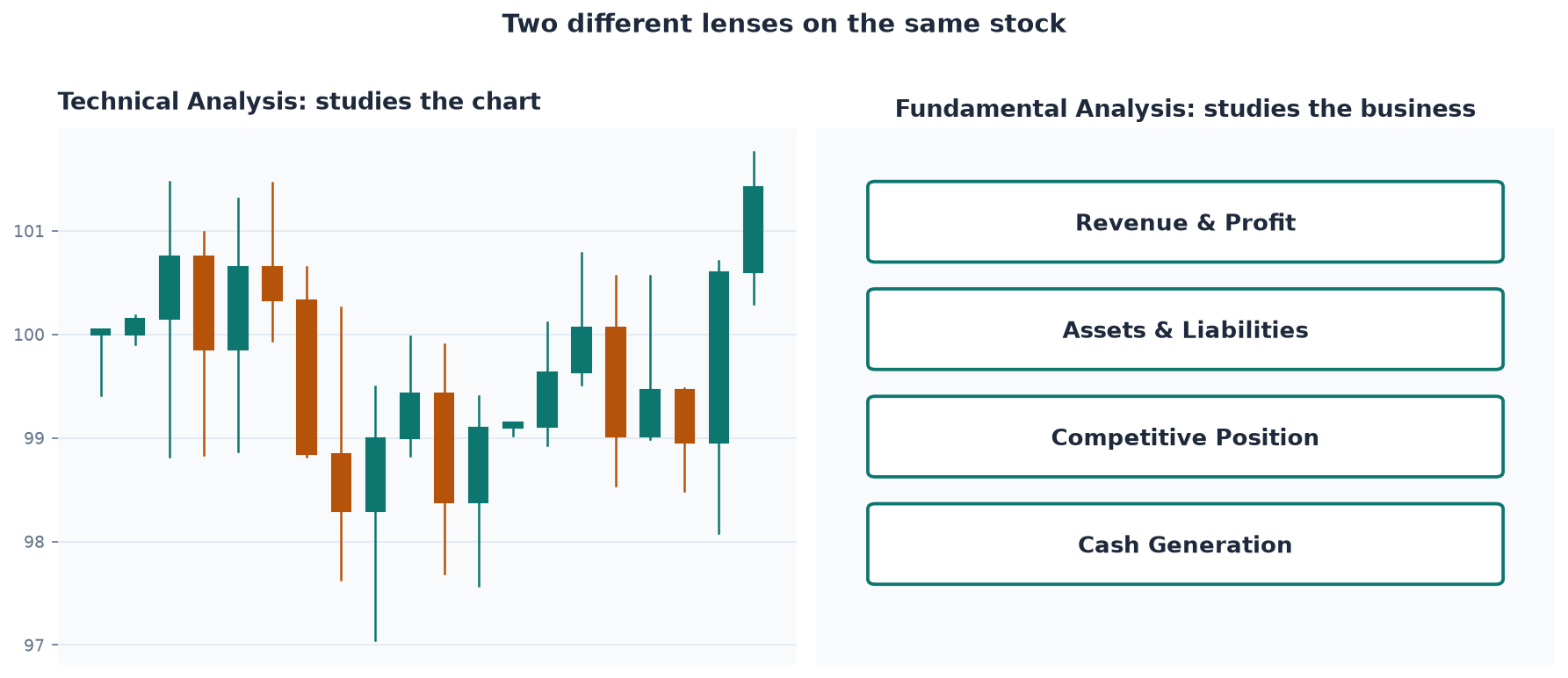
Fundamental analysis is the practice of estimating what a company is actually worth by examining its business: its assets and liabilities, its revenue and profit, its competitive position, and its capacity to keep generating cash in the future. Where technical analysis studies price and volume on a chart, fundamental analysis studies the underlying business the stock represents a tiny slice of ownership in.
Who Relies on It Most
Fundamental analysis is the primary tool of long-term investors, hedge funds, pension funds, and mutual funds — participants managing large amounts of capital who can’t move in and out of a position quickly and have to justify their holdings to clients or boards over months and years, not days. A long-term investor may genuinely not look at a stock’s daily price for weeks, choosing instead to rely on quarterly and annual financial reports to judge whether the underlying business is getting stronger or weaker. That’s a fundamentally different time horizon than someone trading a chart intraday, and it changes which information actually matters.
Book Value: A Starting Concept
One of the simplest fundamental concepts is book value — a company’s total assets minus its total liabilities, which represents what shareholders would theoretically be left with if the company were liquidated today. A stock trading well below its book value is, on paper, priced below the value of the assets backing it, which is one of the classic signals value investors look for. Book value isn’t a complete picture on its own — it says nothing about future earnings power, management quality, or competitive position — but it’s a useful anchor, especially for asset-heavy businesses where the balance sheet reflects something close to the company’s real economic value.
Short-Term Price Action vs. Long-Term Fundamentals
A stock’s price over any single day, week, or even month can diverge sharply from what fundamental analysis would suggest it’s worth — sentiment, momentum, and short-term trading flows can push a price well above or below what a careful read of the financials would justify. Fundamentals typically matter more as the time horizon lengthens: a company with strengthening revenue and a widening competitive advantage tends to see that reflected in its stock price eventually, even if the path there is anything but a straight line. This is precisely why fundamental and technical analysis tend to answer different questions — fundamentals describe whether a business is a good one, while price action describes what the market is doing with it right now.
What This Course Covers
This course builds the vocabulary and the reading skills needed to assess a company’s fundamentals systematically: the three core financial statements (income statement, balance sheet, cash flow statement), the SEC filings that disclose them, basic valuation methods, the idea of a competitive moat, and the catalysts and red flags that tend to move a stock’s long-term trajectory.