
Building Your Own Trading Plan
Every lesson in this course has covered one piece of the puzzle: instruments and accounts, order mechanics, market depth, tape reading, scanning, catalysts, risk management, stops, journaling, psychology, simulated practice, and the large-cap/small-cap and swing/options landscape beyond day trading. A trading plan is where those pieces stop being separate lessons and become one operating document you actually follow. Without one, every decision gets made in real time, under pressure, which is precisely when judgment is worst.
What a Trading Plan Actually Contains
A usable trading plan is specific enough that someone else could read it and know exactly what you will and won’t do. Vague plans (“trade good setups, manage risk well”) aren’t plans at all — they’re intentions. A real plan answers, in writing, questions like: Which instruments and market-cap tier am I trading? What specific catalyst and technical criteria qualify a stock for my watchlist? What is my maximum risk per trade, in dollars and as a percentage of account size? What is my daily maximum loss, after which I stop trading for the day regardless of how I feel? How many trades will I take per day at most? What time of day do I trade, and when do I stop? Which setups, specifically, am I looking for — not “momentum breakouts” in the abstract, but the exact combination of catalyst, volume, and chart pattern that has to be present?
Why Specificity Matters More Than Sophistication
A simple plan followed consistently outperforms a sophisticated plan followed inconsistently, every time. The value of writing it down isn’t that it makes you a better analyst — it’s that it removes decisions from the moment of maximum emotional pressure. When a position is down and the account is bleeding, a trader without a plan negotiates with themselves about whether “this time is different.” A trader with a written max-loss rule just closes the position, because the decision was already made in advance, calmly, with no money on the line in that instant.
The Plan Is a Living Document, Not a Contract Set in Stone
A trading plan should change — but only through the same deliberate process used in the trade-review lesson: looking at a journal of actual results over a meaningful sample size, identifying what specifically isn’t working, and making one change at a time. A plan that gets rewritten every time a trade goes badly isn’t a plan, it’s a reaction. The distinction is review cadence: adjustments happen weekly or monthly based on patterns in the data, not intraday based on how the last trade felt.
Starting Point: A Minimal Viable Plan
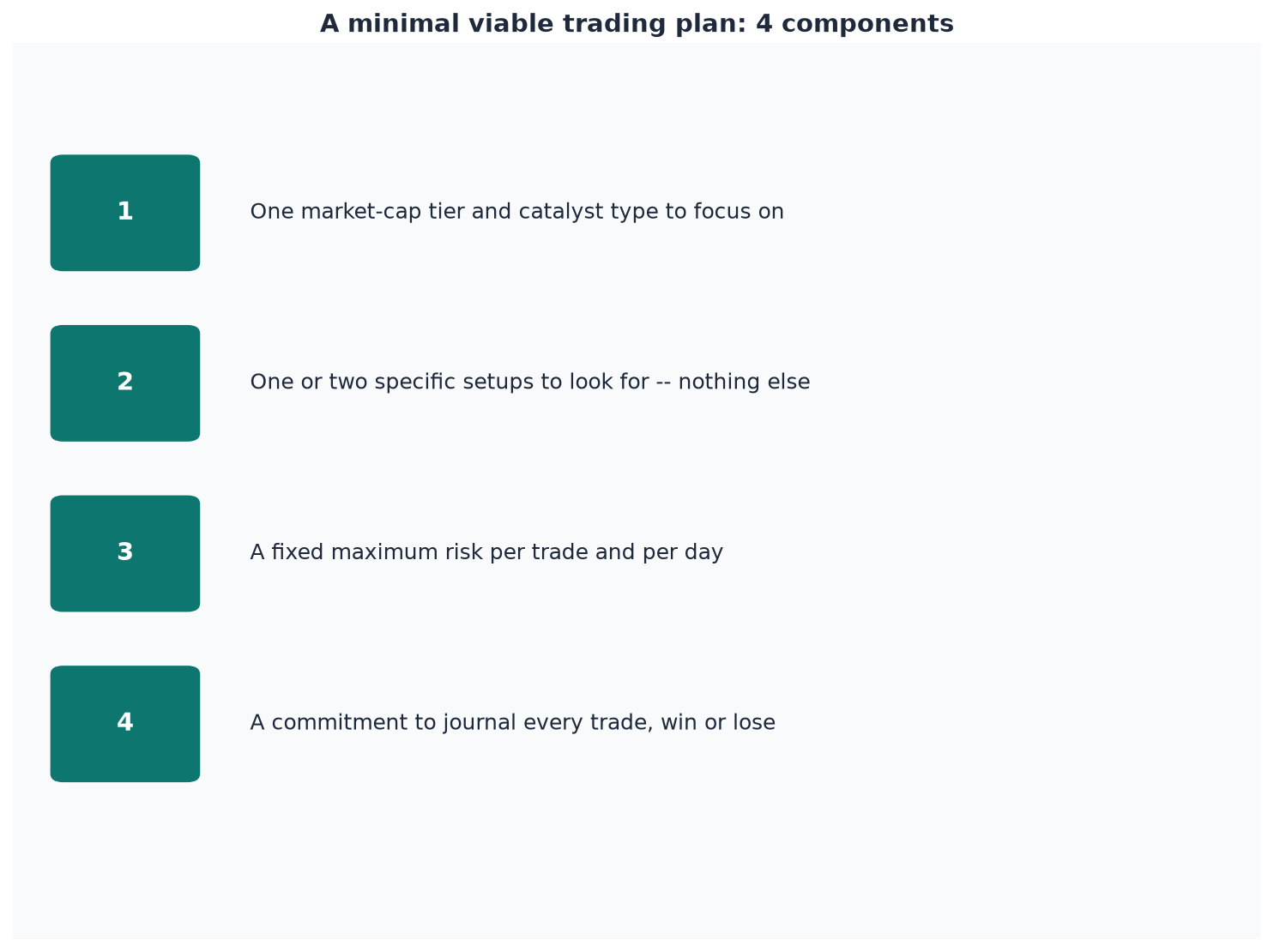
A new trader doesn’t need an elaborate plan on day one — a minimal version with four components is enough to start sim trading with structure: one market-cap tier and catalyst type to focus on, one or two specific setups to look for and nothing else, a fixed maximum risk per trade and per day, and a commitment to journal every trade with the reason for entry and exit. Everything else — refinements to entry timing, position scaling, additional setups — gets added only after that minimal plan has been tested in the simulator and the journal shows what’s actually working. That is, in the end, the real takeaway of this entire course: trading is a discipline built from a small number of well-understood rules, applied consistently, and refined slowly based on evidence rather than impulse.