
An Introduction to Swing Trading and Options
Everything covered so far in this course has been about day trading — opening and closing positions within the same session. Day trading isn’t the only way to apply the same analytical toolkit (catalysts, risk management, technical levels, tape reading). Two other approaches worth understanding, even briefly, are swing trading and options trading. Neither is inherently better or worse than day trading — they trade off time commitment, capital requirements, and risk character differently.
Swing Trading: Holding Across Days
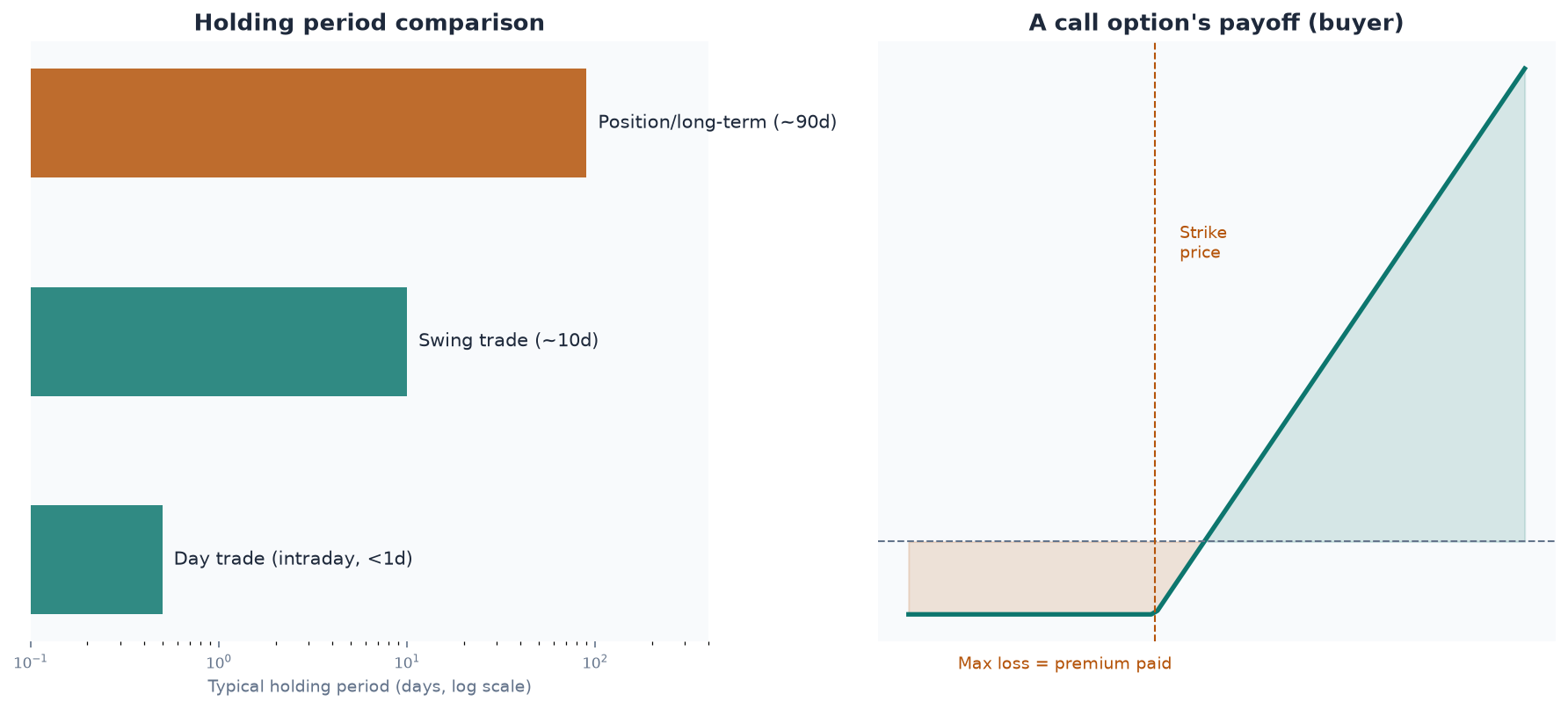
Swing trading holds a position for anywhere from a few days to a few weeks, aiming to capture a larger directional move than a single session typically offers. Because the holding period is longer, swing traders rely more heavily on daily and weekly chart patterns than on the minute-by-minute tape. A swing trade might be built around a stock breaking out of a multi-week consolidation range, a stock finding support at a 50-day moving average, or an earnings catalyst that’s expected to produce a multi-day trend rather than a single-day spike.
The practical appeal of swing trading is that it doesn’t require sitting at a screen all day — a position can be checked once or twice daily. The trade-off is overnight and weekend risk: news can break while the market is closed, and a swing position can gap against you at the next open with no opportunity to exit at your intended price. Position sizing for swing trades typically needs to be smaller than a day trade with an equivalent stop distance, precisely because that gap risk can’t be managed intraday.
Options: Buying and Selling Contracts
An option is a contract that gives its buyer the right (not the obligation) to buy (a call) or sell (a put) a stock at a specific price (the strike price) by a specific date (the expiration). Options let a trader express a directional view with defined, limited risk on the buy side — a call buyer’s maximum loss is the premium paid, regardless of how far the stock moves against the position. That asymmetry is the main draw: small, defined risk with theoretically large upside if the stock moves far enough in the right direction before expiration.
The cost of that defined risk is time decay (theta): an option loses value every day that passes, all else equal, because the window for the stock to make the needed move keeps shrinking. A trader can be right about direction and still lose money if the move happens too slowly or the option was priced too expensively (high implied volatility) to begin with. Selling options (writing contracts) inverts the risk profile — the seller collects the premium upfront but can face losses that are much larger than the premium received if the stock moves sharply against the position, particularly with uncovered (“naked”) calls. Options are a more complex instrument than straight stock ownership and carry risks, including the potential for rapid and total loss of the premium paid, that deserve dedicated study well beyond this overview before committing real capital.
Why Mention These Here
The point of this lesson isn’t to teach swing or options trading in depth — each deserves its own course. It’s to make clear that the skills built throughout this course (reading a catalyst, managing risk, respecting technical levels, journaling results) aren’t exclusive to day trading. They transfer directly to longer time horizons and to derivative instruments. Which approach, or combination of approaches, fits a given trader depends on account size, time available to watch the market, and comfort with overnight risk versus intraday risk — the same self-assessment this course has emphasized from its first lesson.